Introduction to Complex Numbers
The set of complex numbers, denoted by $\mathbb{C}$, is a set of numbers that extends the real numbers. It introduces a special number called imaginary unit, denoted by $i$ and defined by $$ i^2 = -1 $$
A complex number, in its algebraic form, is therefore defined as: $$ z = a + ib, \ \ a, b \in \mathbb{R} $$
Where $a$ denotes the real part ($\Re(z)$) and $b$ denotes the imaginary part ($\Im(z)$). When $\Re(z) = 0$ we say that $z$ is a purely imaginary number. The complex set $\mathbb{C}$ includes all numbers of this form.
Complex numbers are useful because, among other things, they allows us to solve all kinds of polynomial equations, even those that do not have solutions in $\mathbb{R}$. This is guaranteed by the fundamental theorem of algebra which states that every non-constant polynomial equation of degree $n \geq 1$ with complex coefficients has exactly $n$ complex solutions counted with multiplicity. For example, the equation: $$ x^2 + 1 = 0 $$
cannot be solved in $\mathbb{R}$ since there is no real number whose square is equal to $-1$. However, it’s solvable in $\mathbb{C}$ giving the following two complex roots: $$ x = \pm i $$
Algebraic operations
Just like any other number systems, we can define algebraic operations on complex numbers as well. Given two complex numbers $$ z_1 = (a + ib), \ \ z_2 = (c + id) $$
we define the addition and the subtraction as: $$ z_1 \pm z_2 = (a \pm c) + i(b \pm d) $$
The product, instead, is defined as:
$$ z_1 \cdot z_2 = (a + ib) (c + id) = ac + iad + ibc + i^2 bd $$
Finally, the division, can be derived as follows:
$$ \frac{z_1}{z_2} = \frac{a + ib}{c + id} \cdot \frac{c - id}{c - id} = \frac{(ac + bd)+i(bc-ad)}{c^2 + d^2} $$
Complex numbers also allow to define a special operation called complex conjugate defined as follows: $$ \overline{z}_1 = a - ib $$
Geometrically, this operation represent the symmetric of the $z$ on the real axis.
Geometrical representation
Complex numbers can be represented graphically on the Gauss-Argand plane. Given an arbitrary $z \in \mathbb{C}$, the $x$-axis of the plane corresponds to $\Re(z)$, while the $y$-axis corresponds to $\Im(z)$.
For example, let us try to represent the following two numbers:
$$ z_1 = 2 + 3i, \ \ z_2 = -2 - 3i $$
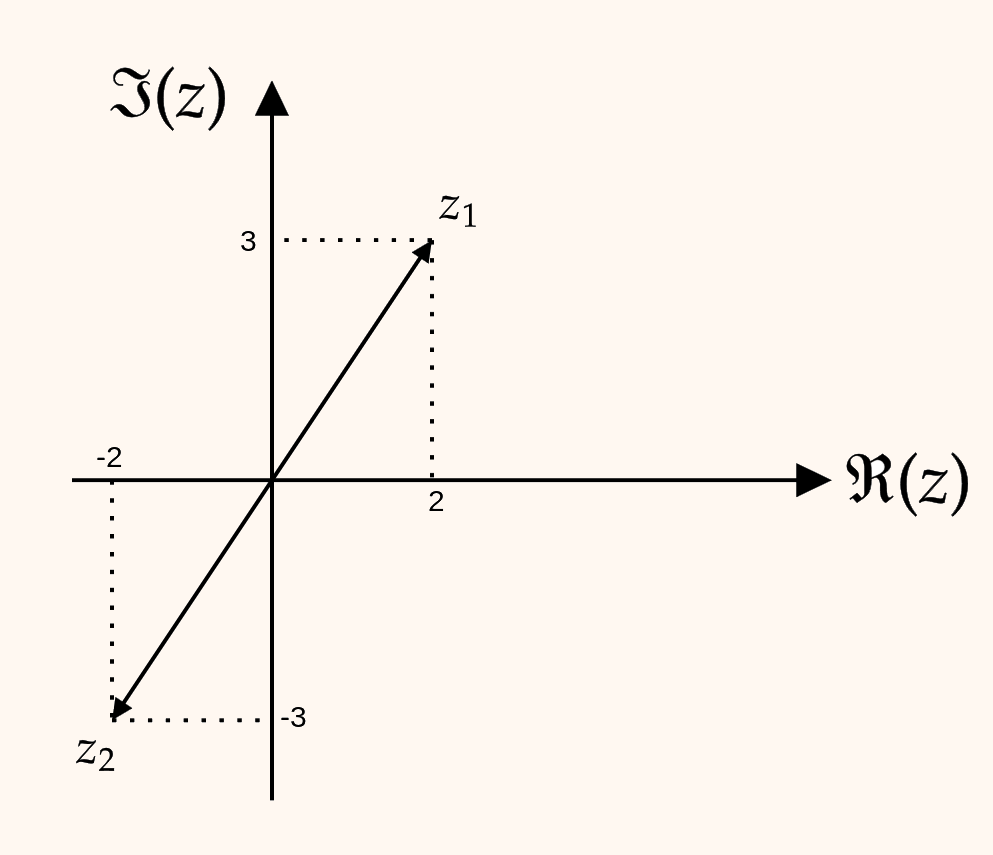
In other words, complex numbers can be seen both as pair of points $P(a,b)$ and as vectors starting from the origin $O(0,0)$ and connecting $P$.
The modulus (or absolute value) is the length of this distance, which is defined as:
$$ |z| = \rho = \sqrt{a^2 + b^2} $$
The modulus allows us to highlight one core feature of complex numbers:
$$ z \cdot \overline{z} = (a + ib)(a - ib) = a^2 + b^2 = |z|^2 $$
The other fundamental component is the argument (or phase) which is the angle formed by the vector representing $z$ with the positive real half-axis.
It is defined by: $$ \tan(\theta) = \frac{b}{a} \implies \theta = \arctan\left(\frac{b}{a}\right), \ \ a \neq 0 $$
Therefore when determining the argument of the arctangent, we must take the quadrant of $z$ into account. In particular, if $a < 0$, the result obtained from the ordinary arctangent must be adjusted by adding or subtracting $\pi$. If $a = 0$, the argument is instead $\frac{\pi}{2}$ or $-\frac{\pi}{2}$, depending on the sign of $b$.
Polar form
So far, we have defined complex numbers in the usual algebraic form; that is: $a \pm ib$. The Gauss plane, however, allows us to represent them in another notation known as polar form which involves both the modulus and the argument.
Let’s start by noting that on the complex plane $a = \rho \cos(\theta)$ and $b = \rho \sin (\theta)$. If we substitute them on the algebraic form $z = a \pm ib$, we get:
$$ z = \rho \cos(\theta) \pm \rho i \sin(\theta) = \rho (\cos(\theta) \pm i \sin(\theta)) $$
Which is exactly the polar form.
The polar form is extremely useful for algebraic manipulation since it allows to express products as a multiplication of moduli and as a sum of arguments. Similarly, it allows to express divisions as a division of moduli and a subtraction of arguments.
Last but not least, we can also derive this neat little formula (De Moivre’s formula) to compute the $n$-th power of a complex number:
$$ z^n = \rho^n (\cos (n \theta) + i \sin(n \theta)) $$
Exponential form
A concise alternative for representing complex numbers expressed in polar notation is the exponential form, which is based on the following Euler’s identity:
$$ e^{i \theta} = \cos {\theta} + i \sin {\theta} $$
Given a complex number $z \in \mathbb{C}$ in polar form, we can express it in exponential notation with the following substitution: $$ z = \rho (\cos(\theta) \pm i \sin (\theta)) = \rho e^{i \theta} $$
Let’s now see some practical examples of conversions between the various representation introduced so far. Let $z \in \mathbb{C}$ be a complex number defined as follows:
$$ z = -1 + i \sqrt{3} $$
Where $\Re(z) = -1$ and $\Im(z) = \sqrt{3}$.
Let’s start by finding the modulus ($\rho$):
$$ \rho = \sqrt{a^2 + b^2} = \sqrt{(-1)^2 + (\sqrt{3})^2} = \sqrt{4} = 2 $$
and then the argument ($\theta$):
$$ \theta = \arctan\left( \frac{b}{a} \right) = \arctan \left( \frac{\sqrt{3}}{-1} \right) = \arctan \left( - \sqrt{3} \right) = - \frac{\pi}{3} $$
Since $a < 0$, we also need to add $\pi$, obtaining: $$ \theta = - \frac{\pi}{3} + \pi = \frac{2}{3} \pi $$
From here, we can immediately derive both the polar and the exponential forms of $z$:
- polar form: $z = 2 \left( \cos \left( \frac{2}{3} \pi \right) + i \sin \left( \frac{2}{3} \pi \right) \right)$;
- exponential form: $z = 2e^{i \frac{2}{3} \pi}$.
Let’s now do the opposite: we will start from the following complex number expressed in exponential form and will try to express it in algebraic notation.
$$ z= 4 e^{i \frac{7}{4} \pi} $$
We have that $\rho = 4$ and $\theta = \frac{7}{4} \pi$. Therefore, in polar form, $z$ becomes: $$ z = 4 \left (\cos \left( \frac{7}{4} \pi \right) + i \sin \left( \frac{7}{4} \pi \right) \right) $$
Let’s now convert it to algebraic form. We can see that $\frac{7}{4} \pi = 315^\circ$; thus, the number is on the fourth quadrant and therefore: $$ \cos \left( \frac{7}{4} \right) = \frac{\sqrt{2}}{2}, \ \ \sin \left( \frac{7}{4} \pi \right) = - \frac{\sqrt{2}}{2} $$
In algebraic form, $z$ becomes: $$ z = 4 \left( \frac{\sqrt{2}}{2} - i \frac{\sqrt{2}}{2} \right) = 2 \sqrt{2} - i \sqrt{2} $$
Solving complex equations
We have now all the tools needed to solve a polynomial equations in $\mathbb{C}$. To do this, we will highlight two methods: the former, which is more general, converts the constant term to exponential form and then proceeds from there. The latter, instead, uses the well-known solving formula used for 2nd-degree equations.
Let $$ p(z) = z^3 + 8 \iff z^3 = -8 $$
be a polynomial equation. For the fundamental theorem of algebra, this equation admits three solutions on $\mathbb{C}$. Let’s start by expressing $-8$ ($z = -8 + i 0$) in exponential form.
Its modulus is: $$ \rho = \sqrt{-8^2 + 0^2} = \sqrt{64} = 8 $$
And since $-8$ lies on the negative real axis, one of its arguments is: $$ \arg(-8) = 0 + \pi = \pi $$
Therefore, all of its arguments are:
$$ \pi + 2k\pi, \ \ k \in \mathbb{Z} $$
Resulting in the following exponential form:
$$ -8 = 8e^{i (\pi + 2k \pi)}, \ \ k \in \mathbb{Z} $$
Then, we need to do the same for the unknown term $z$:
$$ z = re^{i \phi} $$
The equation becomes:
$$ (r e^{i \phi})^3 = 8 e^{i (\pi + 2k \pi)} \iff r^3 e^{i 3 \phi} = 8 e^{i (\pi + 2k \pi)} $$
Let’s now determine both modulus and argument:
- $r^3 = 8 \implies r = \sqrt[3]{8} = 2$;
- $3 \phi = \pi + 2k \pi \implies \phi = \frac{\pi + 2k \pi}{3}$.
From here, we can easily determine the three solutions of $p(z)$. Let’s start from $k = 0$:
$$ \phi_0 = \frac{\pi}{3} \implies z_0 = 2e^{i \frac{\pi}{3}} $$
Therefore:
$$ 2 \left( \cos \frac{\pi}{3} + i \sin \frac{\pi}{3} \right) = 2 \left( \frac{1}{2} + i \frac{\sqrt{3}}{2} \right) = \boxed{1 + i \sqrt{3}} $$
Let’s proceed with $k=1$:
$$ \phi_1 = \frac{\pi + 2 \pi}{3} = \frac{3 \pi}{3} = \pi \implies z_1 = 2 e^{i \pi} $$
Therefore:
$$ 2 ( \cos \pi + i \sin \pi) = 2(-1 + 0) = \boxed{-2} $$
Finally, let’s find the third solution with $k = 2$:
$$ \phi_2 = \frac{\pi + 4 \pi}{3} = \frac{5 \pi}{3} \implies z_2 = 2e^{i \frac{5}{3} \pi} $$
Therefore:
$$ 2 \left( \cos \frac{5}{3} \pi + i \sin \frac{5}{3} \pi \right) = 2 \left( \frac{1}{2} - i \frac{ \sqrt{3}}{2} \right) = \boxed{1 - i \sqrt{3}} $$
The other way to solve this equation is to recognize that $p(z)$ can be expressed as a sum of cubes. That is: $$ p(z) = z^3 + 8 = z^3 + 2^3 = (z+2)(z^2 - 2z + 4) $$
From there, we can immediately derive the solution $z_1 = -2$. Now let’s focus on $$ z^2 - 2z + 4 $$
As stated before, we can solve this using the following well-known solving formula: $$ z_{2,3} = \frac{2 \pm \sqrt{(-2)^2 - 4(1)(4)}}{2} = \frac{2 \pm \sqrt{-12}}{2} $$
Since we’re operating on $\mathbb{C}$, we can rewrite $\sqrt{-12}$ as: $$ \sqrt{-12} = \sqrt{-4 \cdot 3} = 2i \sqrt{3} $$
Therefore: $$ z_2 = 1 + i \sqrt{3}, \ \ z_3 = 1 - i \sqrt{3} $$
In both cases, the set of all solutions of $p(z)$ is: $$ \{ z_0 = 1 + i \sqrt{3}, \ z_1 = -2, \ z_2 = 1 - i \sqrt{3} \} $$
Topology of the complex plane
Let’s conclude this guide with a quick introduction to the topology of the complex plane. As we have seen, complex numbers can be naturally represented as pairs of real numbers:
$$ z = a + ib \iff (a,b) \in \mathbb{R}^2 $$
This identification allows us to equip the complex plane $\mathbb{C}$ with the same topological structure as $\mathbb{R}^2$. Consequently, many topological notions, such as distance, open and closed sets, connectedness and compactness, can be described in terms of their counterparts in the real plane.
Metric of the complex plane
Let us begin with the metric on $\mathbb{C}$.
Recall that on $\mathbb{R}$, the neighborhood of a point $x_0$ with radius $r>0$ is the open interval
$$ (x_0 - r, x_0 + r) $$
which can equivalently be described as the set of points whose distance from $x_0$ is less than $r$:
$$ \{ x \in \mathbb{R} : | x - x_0 | < r \} $$
In $\mathbb{C}$, the distance between two points $z_1, z_2 \in \mathbb{C}$ is defined by:
$$ d(z_1, z_2) = | z_1 - z_2 | $$
where $| \cdot |$ denotes the complex modulus as defined on the previous sections.
Thus, the analogue of an open interval in $\mathbb{C}$ is an open disk. The open disk centered at $z_0 \in \mathbb{C}$ with radius $r > 0$ is:
$$ B_r (z_0) = \{ z \in \mathbb{C} : | z - z_0 | < r \} $$
Geometrically, under the identification $\mathbb{C} \simeq \mathbb{R}^2$, this is the interior of a circle centered at $z_0$. In other words, while neighborhoods in $\mathbb{R}$ are open intervals, neighborhoods in $\mathbb{C}$ are open disks.
Open and closed sets
Once the notion of an open disk has been introduced, we can define open sets.
A set $U \subseteq \mathbb{C}$ is said to be open if, for every point $z \in U$, there exists a radius $r >0$ such that the entire open disk centered at $z$ is contained in $U$:
$$ \forall z \in U, \ \ \exists r > 0 : B_r(z) \subseteq U $$
For example, consider the unit disk
$$ D = \{ z \in \mathbb{C} : |z| < 1 \} $$
This set is open, since every point inside the disk has a sufficiently small neighborhood that remains entirely inside $D$.
On the other hand,
$$ \overline{D} = \{ z \in \mathbb{C} : |z| \leq 1 \} $$
is not open. Indeed, points on the boundary $|z| = 1$ do not have any open disk centered at them that is entirely contained in the set.
As set $F \subseteq \mathbb{C}$ is closed if its complement $\mathbb{C} \setminus F$ is open. Equivalently, a closed set contains all of its accumulation points.
Connectedness
Another important topological notion is connectedness, which, roughly speaking, describes whether a set consists of a single chunk rather than being separated into distinct parts.
In $\mathbb{C}$, an open set $\Omega \subseteq \mathbb{C}$ is called path-connected if any two of its points can be joined by a continuous curve that lies entirely inside $\Omega$.
For open subsets of $\mathbb{C}$, connectedness and path-connectedness are equivalent. Therefore, a non-empty connected open set is also path-connected. Such a set is called a domain. A domain has an additional topological property if every closed curve contained in it can be continuously contracted to a single point without ever leaving the domain. Such type of domain is said to be simply connected.
For example, the whole complex plane $\mathbb{C}$ and an open disk are simply connected. In contrast, the punctured plane $\mathbb{C} \setminus \{ 0 \}$ is not simply connected since a closed curve winding once around the origin cannot be contracted to a point without crossing the missing point $0$.
Differences with the real plane
There are two important ways in which the complex plane differs from the real line. The first one is that $\mathbb{C}$ is not an ordered field; meaning that there is no natural notion of positive or negative directions analogous to those on $\mathbb{R}$.
The second one is its behavior at infinity. While the real line has two distinct directions towards infinity, conventionally represented by $-\infty$ and $+\infty$, the complex plane, instead, has a single point at infinity, meaning that moving sufficiently far away from the origin in any direction leads towards the same point at infinity.
Topologically, we can make this idea precise by adding a single point $\infty$ to $\mathbb{C}$:
$$ \widehat{\mathbb{C}} = \mathbb{C} \cup \{ \infty \} $$
The resulting space is called extended complex plane or, from a geometric standpoint, the Riemann sphere. This concept can be visualized by identifying the complex plane with a plane tangent to a sphere and projecting points of the plane onto the sphere from the opposite pole. Under this stereographic projection, the additional point $\infty$ corresponds to the pole of the sphere from which the projected is performed.
In other words, the complex plane together with a single point at infinity is topologically homeomorphic to the sphere, that is:
$$ \widehat{\mathbb{C}} = \mathbb{C} \cup \{ \infty \} \simeq S^2 $$