3D Curves
In this lesson we will introduce the concept of parametric curves in three-dimensional space. A parametric curve describes a one dimensional path in space by means of a continuous function of a real parameter.
Let’s begin by defining a parametrization.
Let $\gamma \subseteq \mathbb{R}^3$ and let $$ r : [a.b] \to \mathbb{R}^3, \quad [a,b] \in \subseteq \mathbb{R} $$ be a continuous function defined by: $$ r(t) = (x(t), y(t), z(t)), \quad t \in [a,b] $$ If $$ \gamma = \operatorname{Im}(r) = \left\{ r(t) : t \in [a,b] \right\} $$ then $r$ is called a parametrization of $\gamma$.
Hence, we can give the following definition of parametric curves:
Let $\gamma \subseteq \mathbb{R}^3$ and let $r : [a,b] \to \mathbb{R}^3$ be a parametrization of $\gamma$. The pair $(\gamma, r)$ is called a parametric curve in $\mathbb{R}^3$.
In other words, a set $\gamma$ describes the points that make up the curve, while its parametrization $r$ provides information about how the curve is traversed. In particular, it determines the direction of traversal and, when the parameter represents time, the velocity along the curve.
Graphically, a curve can be represented as follows:
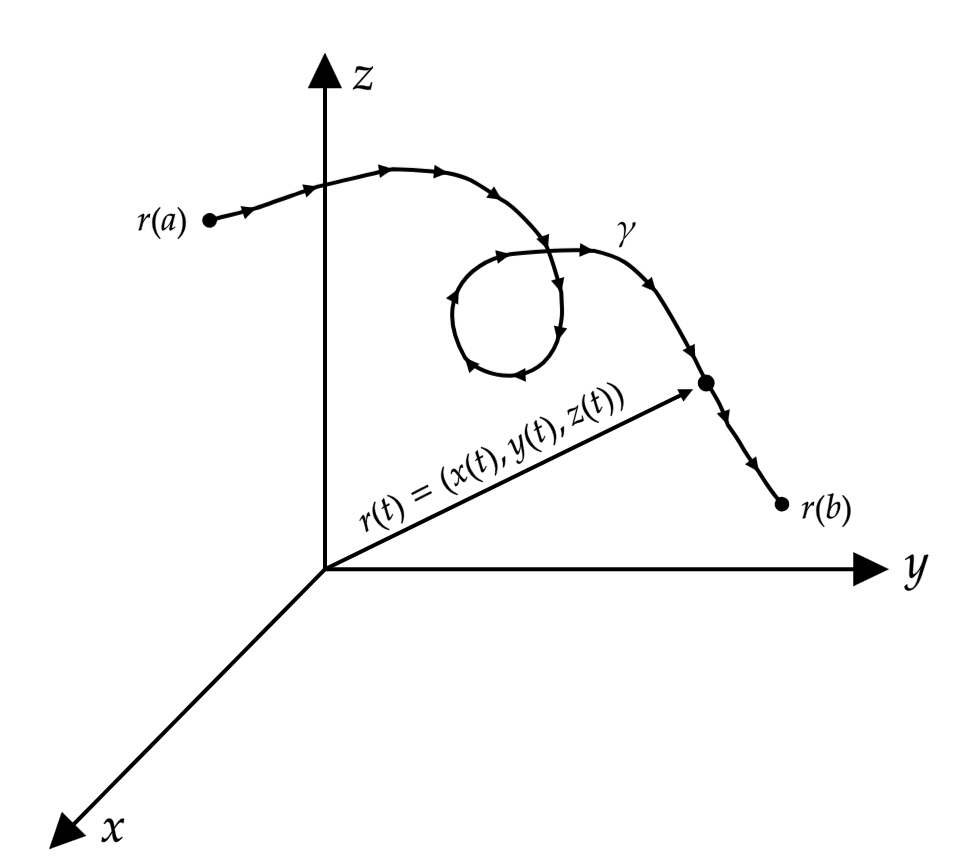
If $r(a) = r(b)$, the curve is said to be closed.
Moreover, if, for every pair $(t_1, t_2) \in [a,b]$ with $t_1 \neq t_2$, the equality $r(t_1) = r(t_2)$ never holds, except possibly when $\{t_1, t_2 \} = \{a, b\}$, then the parametrization is said to be simple. Thus, a simple curve does not intersect itself, except that its initial and final points may coincide.
Finally, a curve is called planar if it is contained in a plane. Therefore, we can establish that:
A planar, simple and closed curve is called a Jordan curve.
Let’s look at some examples. To describe the line segment from $A=(1,0,0)$ to $B=(0,1,2)$, we can choose the following parametrization:
$$ r(t) = (1-t, t, 2t), \quad t \in [0,1] $$
Indeed:
$$ r(0) = (1,0,0) = A, \quad r(1) = (0,1,2) = B $$
Likewise, the circle of radius $1$, centered at the origin in the $xy$-plane, can be described by:
$$ r(t) = (\cos t, \sin t, 0), \quad t \in [0, 2\pi] $$
The coordinates satisfy $x^2 + y^2 = 1$ and $z = 0$. As $t$ varies from $0$ to $2\pi$, the circle is traversed exactly once, counterclockwise when viewed from the positive $z$ -axis.
Notice that the same curve can admit different parametrizations. For instance, the line segment considered above can also be described by:
$$ \widehat{r}(s) = (1-2s, 2s, 4s), \quad s \in \left[ 0, \frac{1}{2} \right] $$
This parametrization describes the same segment but uses a different parameter and therefore a traverses it at a different rate.
Derivative of a Curve
One operation we can perform on a parametrized curve is differentiation.
Given a curve $(\gamma, r)$ where: $$ r(t) = (x(t), y(t), z(t)) $$
if the components functions are differentiable, the derivative of $r$ is defined by: $$ r'(t) = (x'(t), y'(t), z'(t)) $$
The vector $r'(t)$ is the velocity vector of parametrization. It describes how the position changes as the parameter $t$ varies. In particular, it provides the following information:
- Tangent direction: if $r'(t) \neq 0$, the vector $r'(t)$ gives the direction of the tangent line to the curve at $r(t)$;
- Orientation: the vector $r'(t)$ points in the direction in which the curve is traversed as $t$ increases;
- Speed: its magnitude measures how rapidly the position changes with respect to the parameter.
The magnitude of the derivative is defined as:
$$ || r'(t) || = \sqrt{x'(t)^2 + y'(t)^2 + z'(t)^2} $$
If $t$ represents time, this magnitude is the scalar speed of the motion. Additionally, whenever $r'(t) \neq 0$, we can divide the velocity vector by its magnitude and obtain the unit tangent vector (also known as the tangent versor), which is defined as:
$$ T(t) = \frac{r'(t)}{|| r'(t) ||} $$
The unit tangent vector has magnitude $1$ and gives the direction of traversal along the curve. We now have all the prerequisite to define the concept of regular curve.
A parametric curve $(\gamma, r)$ with $r : [a, b] \to \mathbb{R}^3$ is regular if $r \in C^1([a,b])$ and: $$ r'(t) \neq 0, \quad \forall t \in [a,b] $$
If instead $r$ is continuous and there exists a finite partition $$ a = t_0 < t_1 < \dots < t_k = b $$
such that on each subinterval $[t_{i-1}, t_i]$, the restriction of $r$ is continuously differentiable and its derivative does not vanish in the interior $(t_{i-1}, t_i)$, then the curve $(\gamma, r)$ is called a piecewise regular curve.
Length of a curve
Finally, let’s see how to measure the length of a curve.
Let $(\gamma, r)$ be a curve with $r : [a,b] \to \mathbb{R}^3$ and choose a partition $D$ of $[a,b]$ such that:
$$ D = \left\{ a = t_0, \, t_1, \, \ldots, \, t_{n-1}, \, t_n = b \right\} $$
Additionally, for each $k = 0, \ldots, n$, define the points:
$$ p_k = r(t_k) $$
These $n+1$ points lie on $\gamma$ and determine a polygonal chain $\varphi_D$, whose consecutive vertices are joined by straight line segments. Graphically:
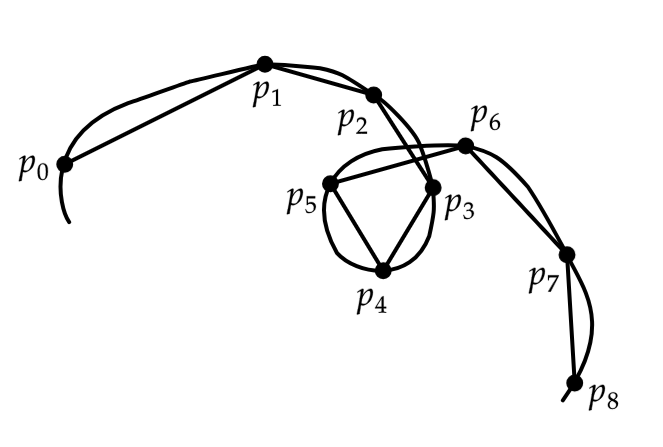
Its length, instead, is:
$$ \begin{aligned} \ell(\varphi_0) &= \Vert p_1 - p_0 \Vert + \Vert p_2 - p_1 \Vert + \cdots + \Vert p_n - p_{n-1} \Vert\\ &= \sum_{k=0}^{n-1} \left\Vert r(t_{k+1} - r(t_k) \right\Vert \end{aligned} $$
We now define the length of the curve as the supremum of the lengths of all polygonal chains obtained from partitions of $[a, b]$, that is:
$$ L = \sup\limits_D \ell(\varphi_D) $$
where the supremum is taken over all partitions $D$ of the parameter interval.
Depending on whether $L$ is finite or infinite, we distinguish between two cases:
- If $L < +\infty$, the curve $(\gamma, r)$ is called rectifiable and $L \in \mathbb{R}$ is its arc length;
- If $L = +\infty$, the curve is not rectifiable and has infinite arc length.
In particular, we have the following result:
Let $(\gamma, r)$ be a regular curve with $r : [a,b] \to \mathbb{R}^3$. Then the curve is rectifiable and its arc length is given by: $$ L = \int_a^b \Vert r'(t) \Vert \, dt $$
As a practical example, consider the unit circle parametrized by:
$$ r(t) = (\cos t, \sin t, 0), \quad t \in [0, 2\pi] $$
Since:
$$ r'(t)=(-\sin t, \cos t, 0), \quad \Vert r’(t) \Vert =1, $$
its arc length is equal to:
$$ L = \int_0^{2\pi} 1 \, dt = 2\pi $$
More generally, a circle of radius $R$ centered at the origin in the $xy$-plane can be parametrized by:
$$ r(t) = (R \cos t, R \sin t, 0), \quad t \in [0, 2\pi] $$
In this case, $\Vert r'(t) \Vert = R$ and therefore its arc length corresponds to:
$$ L = \int_0^{2\pi} R \, dt = 2\pi R $$