Inequalities
An inequality is an expression that states the relationship between two mathematical quantities that are not equal. Just like equations, there are many kind of inequalities and there is no general method for solving them all. In this guide, we will focus on linear, quadratic and fractional inequalities.
In order to efficiently solve this kind of mathematical expression, we need to remember the following algebraic rules:
- You can add or subtract a certain quantity on both sides of the expression without changing the meaning of the inequality;
- You can multiply or divide both sides of the expression by a certain quantity without changing the meaning of the inequality;
- If you multiply or divide both sides of the expression by a negative quantity, you must flip the inequality sign.
Linear inequalities
Let’s start with the simplest case. We want to solve the following inequality:
$$ 3x - 5 < -1 $$
Let’s start by adding $5$ to both sides of the expression:
$$ 3x < 4 $$
Then let’s apply rule n.2 by dividing both sides by $3$. We get the following solution:
$$ x < \frac{4}{3} $$
Let’s try another one:
$$ -4x + 2 < 0 $$
In this case we can subtract $2$ to both sides of the expression and then apply rule n.3 by multiplying both sides by $-1$. Finally, we can apply rule n.2 and divide both sides by $4$:
$$ \begin{aligned} -4x &< -2\\ 4x &> 2\\ x &> \frac{\cancel{2}^1}{\cancel{4}^2} \end{aligned} $$
Quadratic inequalities
Instead, if we have an inequality of the form:
$$ P(x) := ax^2 + bx + c \lesseqgtr 0 $$
We need to distinguish three separate cases. This is because, in order to solve this kind of expression, we use the following well-known formula:
$$ x_{1,2} = \frac{-b \pm \sqrt{b^2 - 4ac}}{2a} $$
Which yields the following outcomes:
-
$\Delta > 0$: we obtain two distinct roots. The solution depends on the sign of $P(x)$:
- $P(x) > 0$ (respectively $\geq 0$): $x < x_1 \vee x > x_2$ (respectively, $\leq$ and $\geq$);
- $P(x) < 0$ (respectively $\leq 0$): $x_1 < x < x_2$ (respectively, $\leq$).
-
$\Delta = 0$: we obtain one root (or, more precisely, two coincident solutions). The solution therefore depends on the sign of $P(x)$:
- $P(x) > 0$: the inequality is true $\forall x \neq x_1$;
- $P(x) \geq 0$: the inequality is true $\forall x \in \mathbb{R}$;
- $P(x) < 0$: there are no real solutions, that is $\nexists x \in \mathbb{R}$;
- $P(x) \leq 0$: the inequality is true only for $x = x_1$.
-
$\Delta < 0$: we get no real roots. Therefore, we can distinguish the following two cases:
- $P(x) > 0$ (respectively, $\geq$): the inequality is true $\forall x \in \mathbb{R}$;
- $P(x) < 0$ (respectively, $\leq$): there are no real solutions, that is $\nexists x \in \mathbb{R}$.
Let’s look at some practical examples.
Example 1
$$ 2x^2 + 5x +3 \geq 0 $$
Let’s try to find its roots:
$$ x_{1,2} = \frac{-5 \pm \sqrt{25 - 24}}{4} \\ x_1 = - \frac{3}{2}, \ \ x_2 = -1 $$
Since $\Delta > 0$, the parabola intersects the $x$-axis at two distinct points, namely $x_1 = - \frac{3}{2}$ and $x_2 = -1$, that is:
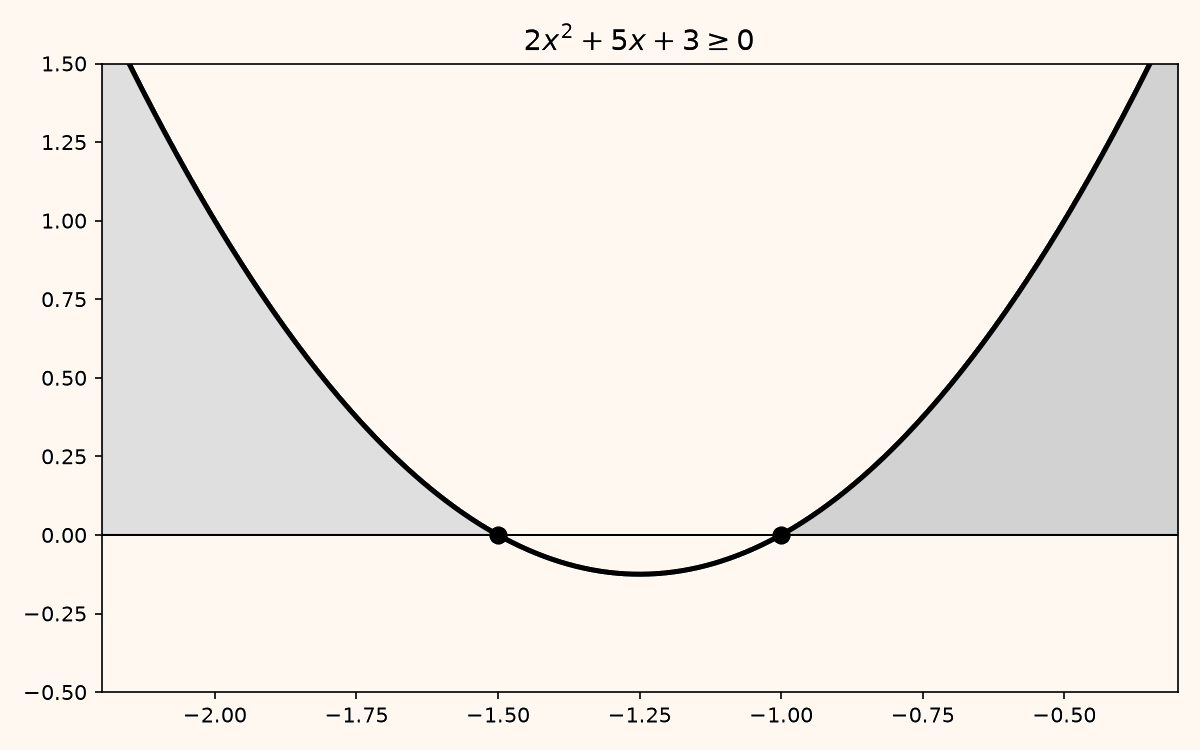
Therefore the inequality is satisfied when: $$ x \leq - \frac{3}{2} \vee x \geq -1 $$
Example 2
$$ -x^2 + 5x + 6 > 0 $$
First of all, let’s apply rule n.3 by multiplying both sides of the expression by $-1$:
$$ x^2 - 5x - 6 < 0 $$
Then, we can solve the associated equation with the following formula:
$$ x_{1,2} = \frac{5 \pm \sqrt{25 + 24}}{2} \\ x_1 = -1, \ \ x_2 = 6 $$
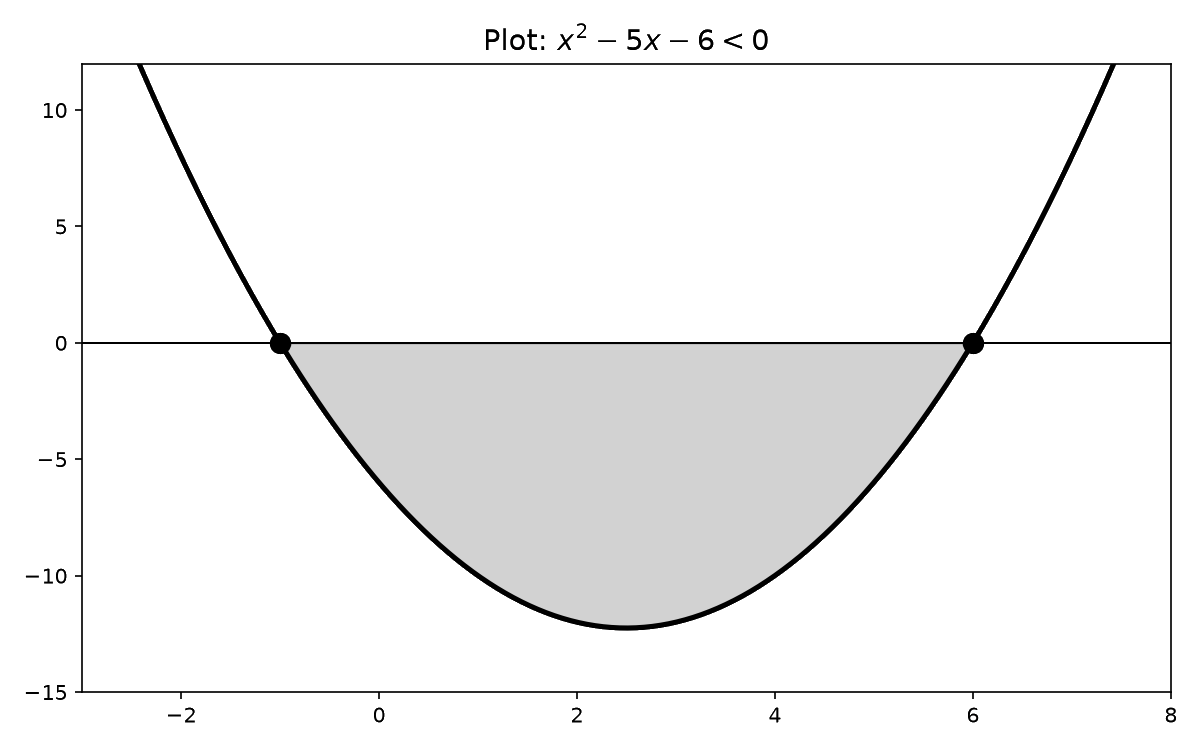
Since $\Delta > 0$, the parabola intersects the $x$-axis at two distinct points. This time, however, we’re asked to determine when the upward-opening parabola has negative values or, equivalently from the original inequality, when the downward-opening parabola has positive values. That is, respectively:
And:
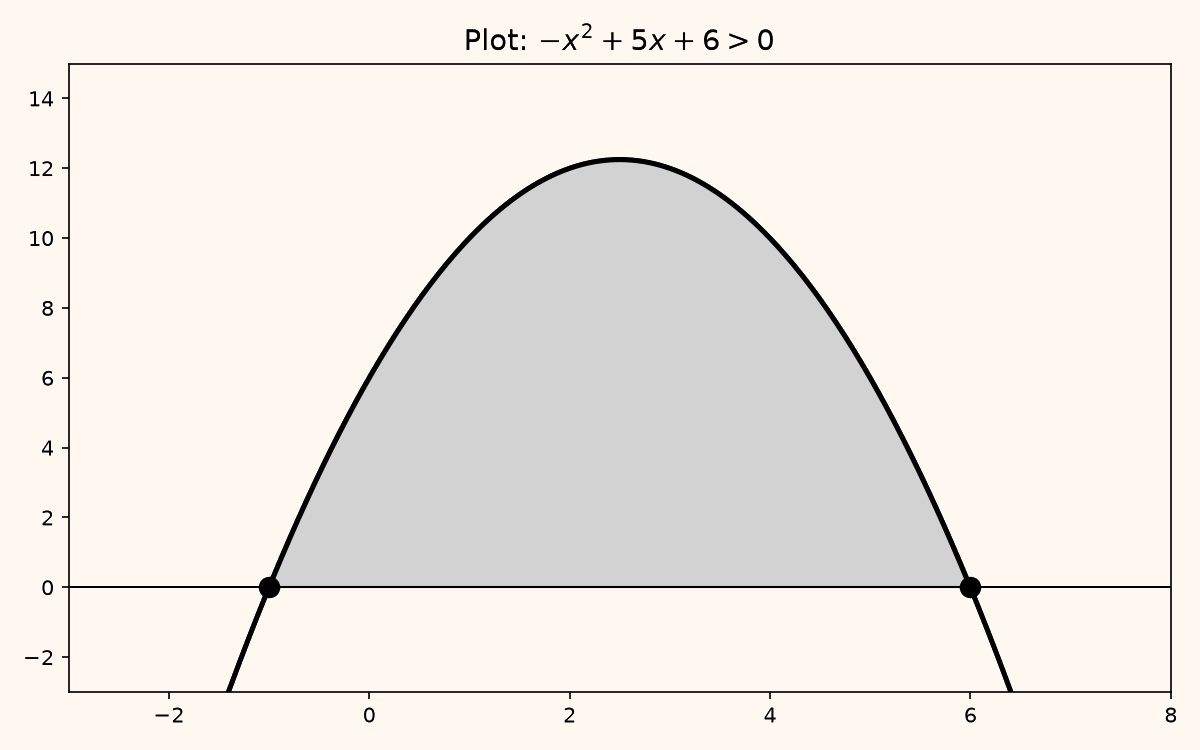
In both cases, this is satisfied when: $$ -1 < x < 6 $$
Example 3
$$ 2x^2 + 4x + 3 > 0 $$
We can apply the solving formula directly since there’s nothing more to do: $$ x_{1,2} = \frac{-4 \pm \sqrt{16 - 24}}{4} \implies \Delta < 0 $$
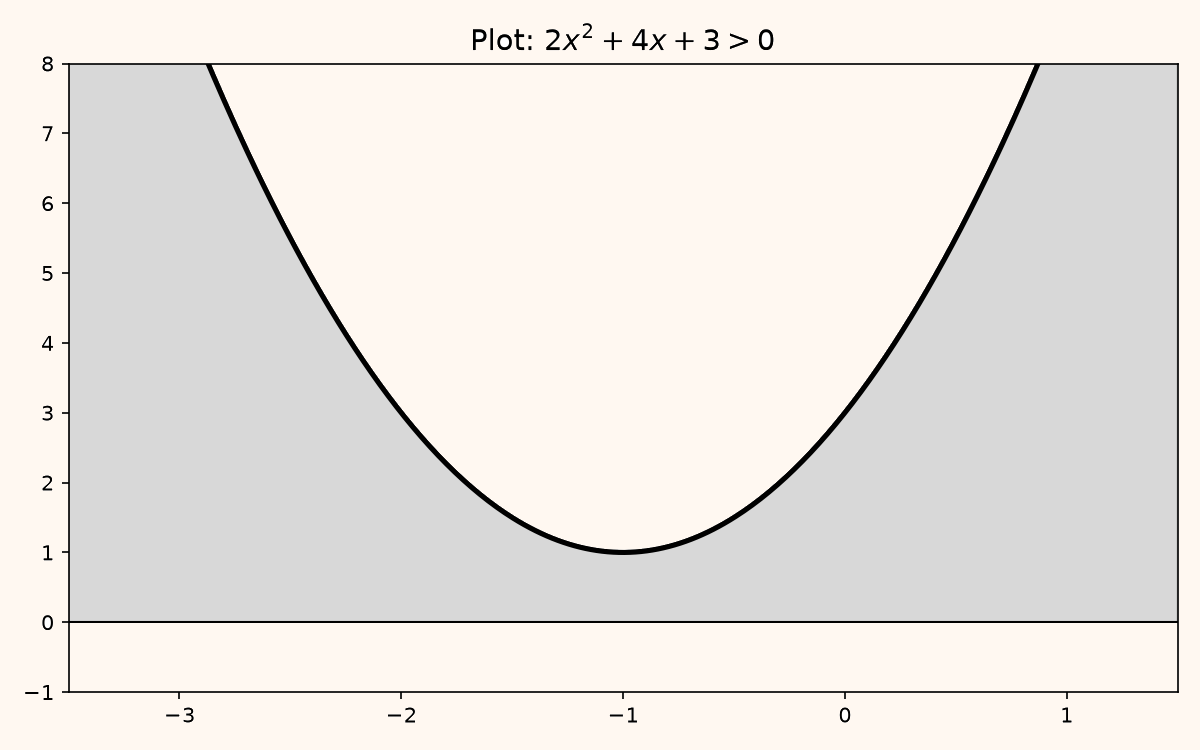
A negative $\Delta$ implies that the equation associated with this inequality has no real solutions. That is, the parabola represented by the equation does not intersect the $x$-axis at any point.
This means that the parabola must lay either on the the first or on the fourth quadrant, but since the coefficient $a = 2$ is positive, the parabola opens upwards and therefore must lay on the first quadrant. This also implies that the original inequality is true for every real value of $x$ ($\forall x \in \mathbb{R}$). Graphically, this is:
Fractional inequalities
Just like equations, inequalities can also contain fractions with an unknown in the denominator. To solve them, we follow a similar procedure:
- Express the inequality in normal form, that is, as a single fraction: $\frac{N(x)}{D(x)} \lesseqgtr 0$;
- Solve the two inequalities separately, that is $N(x) > 0$ (or $\geq$, if required) and $D(x) > 0$;
- Test the interval to determine where the inequality is positive and negative.
Let’s look at some examples.
Example 1
$$ \frac{2x-1}{x} \geq -1 $$
Let’s start by expressing the inequality in normal form:
$$ \frac{2x - 1 + x}{x} \geq 0 \iff \frac{3x - 1}{x} \geq 0 $$
Now, let’s solve the numerator ($\geq 0$) and the denominator ($>$) separately:
$$ \begin{aligned} &N(x) \geq 0 : 3x - 1 \geq 0 \iff x \geq \frac{1}{3}\\ &D(x) > 0 : x > 0 \end{aligned} $$
Now, let’s test the intervals to see where the inequality is positive:
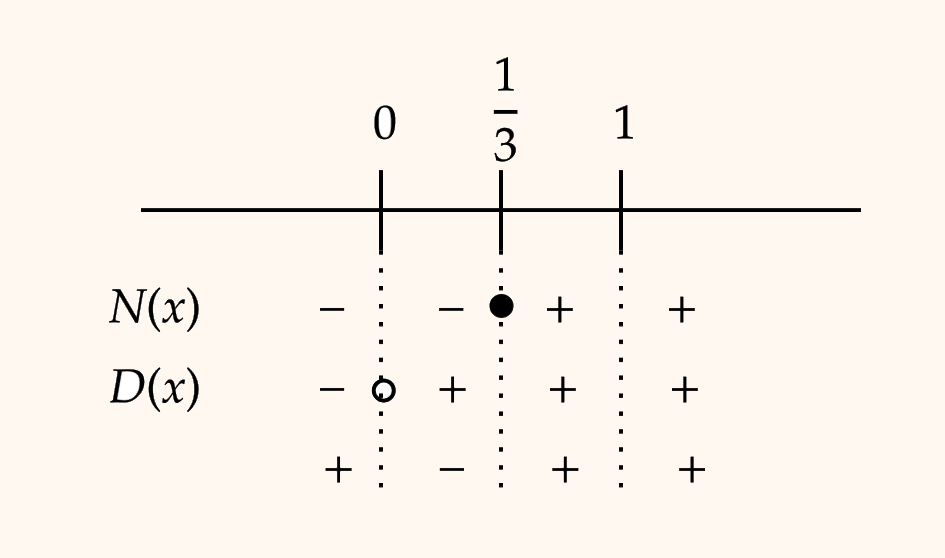
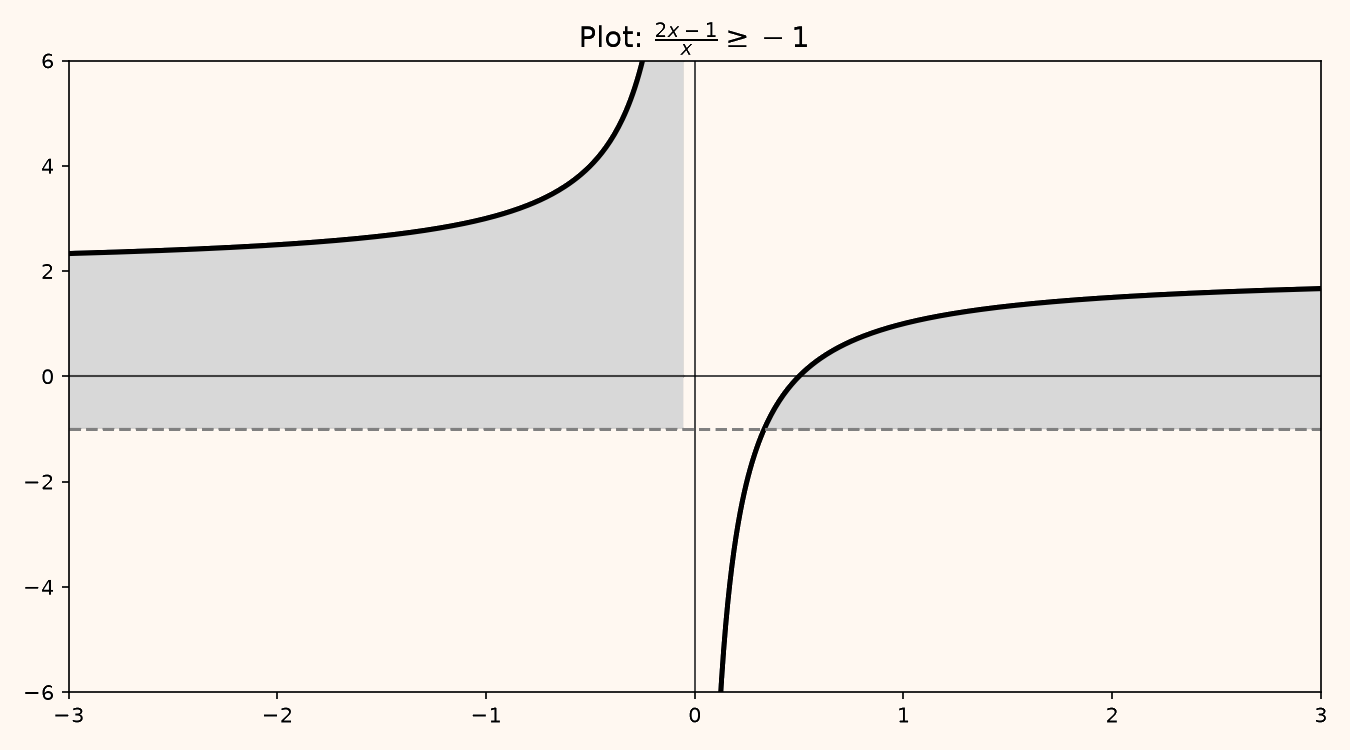
As you can see by the diagram, the inequality is positive when $x$ is less than zero and when $x$ it’s greater or equal than $\frac{1}{3}$. In other words: $$ \begin{aligned} x < 0 &\vee x \geq \frac{1}{3}\\ (-\infty, 0) &\cup \left[ \frac{1}{3}, + \infty \right) \end{aligned} $$
Graphically, that is:
Example 2
$$ \frac{7+x}{2x^2 - x - 1} < 0 $$
It’s a good idea to start by determining which values make the denominator equal to zero. In other words, we want to determine when: $$ 2x^2 - x - 1 = 0 \implies x = - \frac{1}{2} \vee x = 1 $$
These values must be excluded from the domain, therefore: $$ x \neq - \frac{1}{2} \wedge x \neq 1 $$
Now let’s solve the numerator ($>$) and the denominator ($>$) independently:
$$ \begin{aligned} &N(x) > 0 : 7 + x > 0 \iff x > - 7\\ &D(x) > 0 : 2x^2 - x - 1 > 0 \iff x < - \frac{1}{2} \vee x > 1 \end{aligned} $$
Finally, let’s plot the intervals:
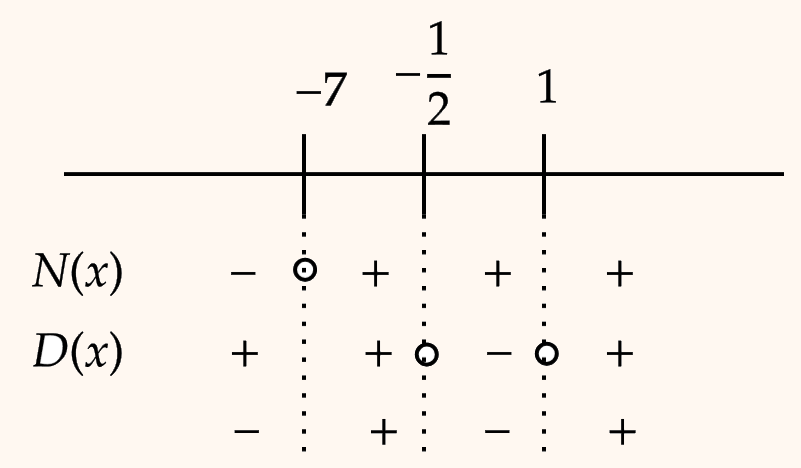
In this case, we want the intervals where the inequality is negative, that is:
$$ \begin{aligned} x < -7 &\vee - \frac{1}{2} < x < 1\\ (-\infty, -7) &\cup (- \frac{1}{2}, 1) \end{aligned} $$