Squeeze Theorem
The squeeze theorem (also known as the two policeman theorem) is a theorem regarding limits of functions (or sequences) that is used to determine the limit of a function bounded between two other functions. Among other things, it can be used to prove that: $$ \lim_{x \to 0} \frac{\sin(x)}{x} = 1 $$
Statement and Proof
The theorem states the following proposition:
Let $x_0 \in \mathbb{R}$ be an accumulation point for an open interval $I$ and let $$ f, g, h : I \setminus \{ x_0 \} \to \mathbb{R} $$ be functions defined on $I \setminus \{ x_0 \}$.
If ($\bigstar$): $$ g(x) \leq f(x) \leq h(x) \ \ \forall x \in I \setminus \{ x_0 \} $$ And: $$ \lim_{x \to x_0} g(x) = \lim_{x \to x_0} h(x) = L \in \mathbb{R} $$ Then: $$ \lim_{x \to x_0} f(x) = L $$
By the $\epsilon$-$\delta$ definition, given $\epsilon > 0$, the fact that $\lim_{x \to x_0} g(x) = L$ implies that there exists $\delta_1 > 0$ such that, $\forall x \in I \setminus \{ x_0 \}$, we have:
$$ 0 < | x - x_0 | < \delta_1 \implies |g(x) - L| < \epsilon $$
which expands to ($\clubsuit$): $$ L - \epsilon < g(x) < L + \epsilon $$
Likewise, $\lim_{x \to x_0} h(x) = L$ implies that there exists $\delta_2 > 0$ such that $\forall x \in I \setminus \{ x_0 \}$, we have:
$$ 0 < | x - x_0 | < \delta_2 \implies | h(x) - L| < \epsilon $$
which expands to ($\spadesuit$):
$$ L - \epsilon < h(x) < L + \epsilon $$
Now, let $\delta = \min(\delta_1, \delta_2) > 0$ and assume that $0 < | x - x_0 | < \delta$. Since: $$ 0 < | x - x_0 | < \delta \leq \delta_1 $$
And
$$ 0 < | x - x_0 | < \delta \leq \delta_2 $$
Both conditions hold simultaneously. If we now take the outer left part of $\clubsuit$ and the outer right part of $\spadesuit$ and we combine them with the hypothesis $\bigstar$, we obtain: $$ L - \epsilon < g(x) \leq f(x) \leq h(x) < L + \epsilon $$
If we take the outer ends of the inequality, we conclude that:
$$ L - \epsilon < f(x) < L + \epsilon \implies | f(x) - L| < \epsilon $$
Therefore:
$$ \lim_{x \to x_0} f(x) = L\\ \blacksquare $$
Practical Example
As stated at the beginning of this post, this theorem can be used to evaluate the following limit: $$ \lim_{x \to 0} \frac{\sin(x)}{x} = 1 $$
In order to do that, let’s first establish the geometric bounds for $\frac{\sin(x)}{x}$ near $x=0$ using the unit circle:
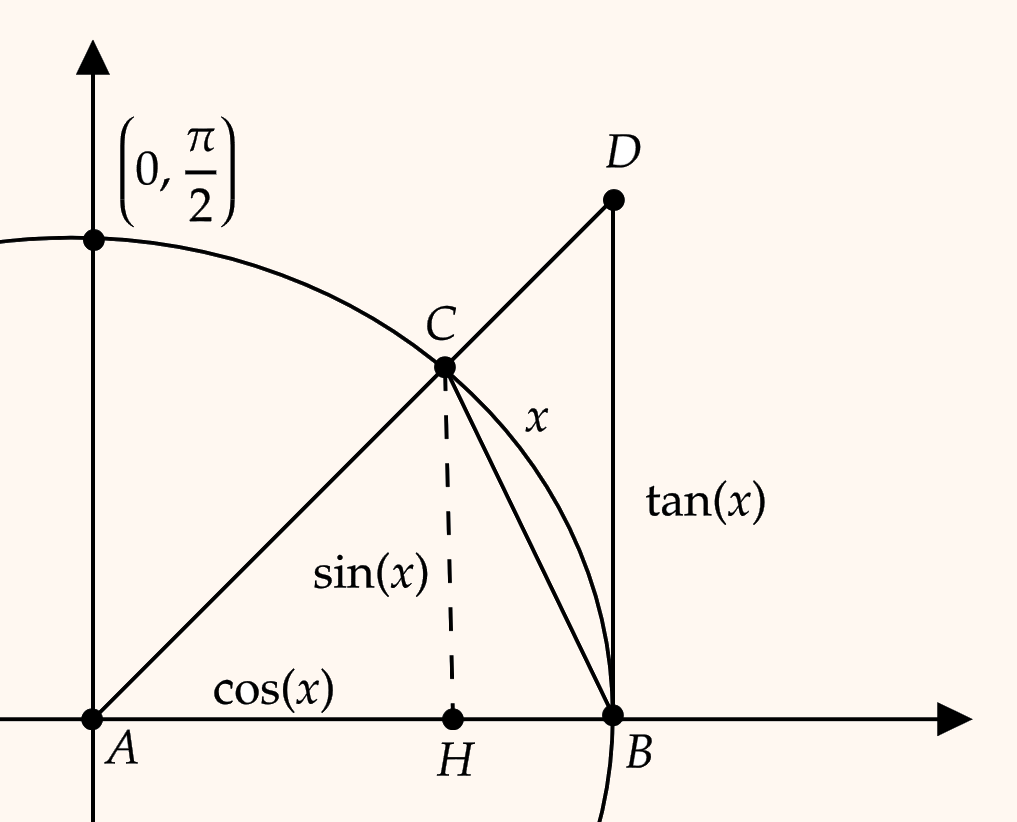
From the previous diagram, let $x \in ( 0, \frac{\pi}{2})$ be the measure in radians of the angle $\angle CAB$. Since the circle has radius $1$, the corresponding arc $CB$ has length $x$.
We can therefore distinguish the following three distinct loci:
- The inner triangle $\triangle ABC$ formed by the origin $A(0,0)$, the point $B(1,0)$ and the point $C(\cos(x),\sin(x))$;
- The circular sector $ABC$ formed by the subtended arc $CB$;
- The outer triangle $\triangle ABD$ formed by the origin $A(0,0)$, the point $B(1,0)$ and the point $D(1, \tan(x))$.
Then, we can calculate the following areas using standard Euclidean geometry:
$$ A_{(\triangle ABC)} = \frac{1}{2} \cdot \text{base} \cdot \text{height} = \frac{1}{2} \cdot 1 \cdot \sin(x) = \frac{1}{2} \sin(x) $$
$$ A_{(\text{sector } ABC)} = \frac{1}{2} r^2 x = \frac{1}{2} (1)^2 x = \frac{1}{2}x $$
$$ A_{(\triangle ABD)} = \frac{1}{2} \cdot 1 \cdot \tan(x) = \frac{1}{2} \tan(x) $$
From here, we deduce that:
$$ A_{(\triangle ABC)} \subset A_{(\text{sector } ABC)} \subset A_{(\triangle ABD)} $$
Hence:
$$ A_{(\triangle ABC)} < A_{(\text{sector } ABC)} < A_{(\triangle ABD)} $$
That is: $$ \frac{1}{2} \sin(x) < \frac{1}{2} x < \frac{1}{2} \tan(x) $$ $$ \sin(x) < x < \tan(x) $$
Since $x \in (0, \frac{\pi}{2})$, $\sin(x) > 0$; therefore, we can divide all terms by $\sin(x)$:
$$ 1 < \frac{x}{\sin(x)} < \frac{\tan{x}}{\sin{x}} $$
And since $\tan(x) = \frac{\sin(x)}{\cos(x)}$:
$$ 1 < \frac{x}{\sin(x)} < \frac{1}{\cos{x}} $$
Now let’s take the reciprocals:
$$ \cos(x) < \frac{\sin(x)}{x} < 1 $$
Let’s now prove that these inequalities don’t change for $x \in (- \frac{\pi}{2}, 0)$. Let $x = -t$ where $t \in (0, \frac{\pi}{2})$, using the fact that sine is odd, that is $\sin(-t) = -\sin(t)$ get:
$$ \frac{\sin(-t)}{-t} = \frac{-\sin{t}}{-t} = \frac{\sin(t)}{t} $$
hence the ratio $\frac{\sin(x)}{x}$ is even. Since $\cos(x)$ is also even, we conclude that:
$$ \cos(x) < \frac{\sin{x}}{x} < 1, \ \ \forall x \in \left(-\frac{\pi}{2}, \frac{\pi}{2} \right) \setminus \{ 0 \} $$
We are finally ready to apply the squeeze theorem. First of all, let’s fix the functions $g,f,h$ and the interval $I$: $$ g(x) = \cos(x), \ \ \ f(x) = \frac{\sin(x)}{x}, \ \ \ h(x) = 1, $$
$$ I = \left(-\frac{\pi}{2}, \frac{\pi}{2} \right) \setminus \{ 0 \} $$
Then, if we evaluate the outer limits as $x \to 0$, we obtain: $$ \lim_{x \to 0} g(x) = \lim_{x \to 0} \cos(x) = 1 $$
And: $$ \lim_{x \to 0} h(x) = \lim_{x \to 0} 1 = 1 $$
Thus, since $\cos(x) < \frac{\sin{x}}{x} < 1$ $\forall x \neq 0$ near origin and both bounding functions approach $1$ as $x \to 0$, by the squeeze theorem, we conclude that: $$ \lim_{x \to 0} \frac{\sin{x}}{x} = 1\\ \blacksquare $$