Triple Integrals
The theory developed in the previous lesson on double integrals can be extended to higher dimensions, including the case of triple integrals. In three dimension dimensions, the set:
$$ Q = [a_1, b_1 ] \times [a_2, b_2] \times [a_3, b_3] $$
represents a rectangular parallelepiped (or box) in $\mathbb{R}^3$. By partitioning each of its three intervals, we obtain a finite collection of smaller rectangular parallelepipeds.
Let $f: Q \to \mathbb{R}$ be a bounded function with $Q \subseteq \mathbb{R}^3$ and let’s partition the three intervals as:
$$ \begin{aligned} a_1&=x_0<\cdots<x_p=b_1,\\ a_2&=y_0<\cdots<y_q=b_2,\\ a_3&=z_0<\cdots<z_s=b_3. \end{aligned} $$
The resulting subrectangles are:
$$ Q_{hkj}=[x_{h-1},x_h]\times[y_{k-1},y_k]\times[z_{j-1},z_j] $$
where $h=1, \ldots, p$, $k=1, \ldots, q$, and $j=1, \ldots, s$ and their side lengths are $\Delta x_h$, $\Delta y_k$, and $\Delta z_j$. On each subrectangle, we can define:
$$ m_{hkj}=\inf\limits_{(x,y,z)\in Q_{hkj}} f(x,y,z), \qquad M_{hkj}=\sup\limits_{(x,y,z)\in Q_{hkj}} f(x,y,z) $$
We can therefore define the lower Riemann sum:
$$ s(D,f)=\sum_{h=1}^{p}\sum_{k=1}^{q}\sum_{j=1}^{s} m_{hkj},\Delta x_h,\Delta y_k,\Delta z_j $$
and the upper Riemann sum:
$$ S(D,f)=\sum_{h=1}^{p}\sum_{k=1}^{q}\sum_{j=1}^{s} M_{hkj},\Delta x_h,\Delta y_k,\Delta z_j $$
As in the one- and two-dimensional cases, a bounded function is Riemann-integrable on (Q) when its upper and lower integrals agree.
Just like for the one and the two dimensional cases, a bounded function is Riemann-integrable on $Q$ when the supremum and the infimum are equal. Formally:
Let $f : Q \to \mathbb{R}$ be a bounded function, with $Q \subseteq \mathbb{R}^3$ is a rectangular parallelepiped. We say that $f$ is Riemann-integrable on $Q$ if: $$ \sup\limits_D s(D,f) = \inf\limits_D S(D, f) $$ In that case, we write: $$ \iiint_Q f(x,y,z) dV = \iiint_Q f(x,y,z) \, dx \, dy \, dz, \quad \mathcal{I}(f) $$
The triple integral accumulates the values of a function throughout a tree dimensional hypersurface. For example, if $f \equiv 1$, the integral gives the volume of $Q$ and if $f$ represents a density, the integral gives the corresponding total mass.
Change of Variables
Just like for the double integral, we can evaluate a triple integral by changing the variables of integration and choosing coordinates that describe the region more naturally. Two particularly useful coordinates system in three dimensions are:
- Cylindrical coordinates ($r, \theta, z$): which are useful for cylinders, pipes, and other solids with rotational symmetry about an axis;
- Spherical coordinates ($\rho, \theta, \varphi)$: which are useful for balls, spherical shells, cones, and solids with spherical symmetry about the origin.
In general, a change of variables can be performed when the transformation is sufficiently regular and one-to-one on the region under consideration, with a non-zero Jacobian determinant and with the relevant integrability hypotheses being satisfied. The cylindrical and spherical coordinate maps have a few coordinate singularities and duplicated boundary values, which occur only on sets of three-dimensional volume zero and don’t affect the underneath integral.
Cylindrical Coordinates
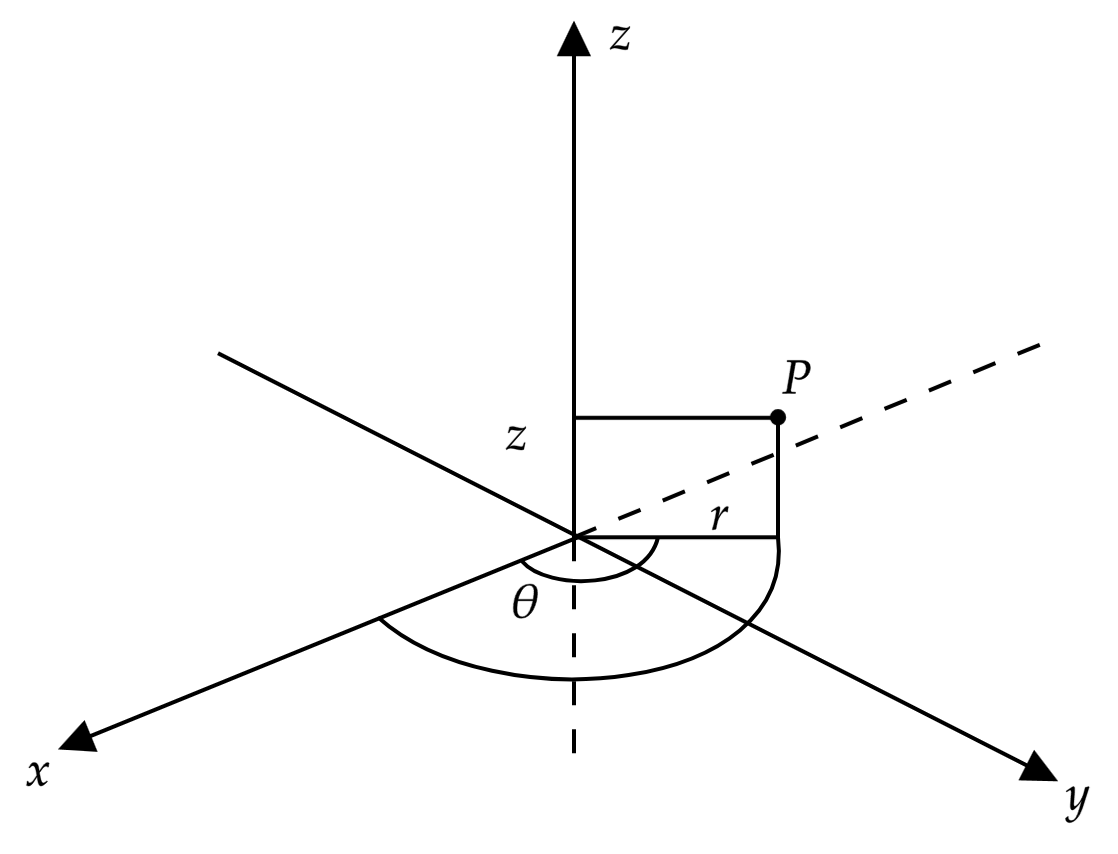
The cylindrical coordinate system is a three-dimensional coordinate system that extends the two-dimensional polar coordinates by adding a vertical height, represented by the coordinate $z$. The substitution, in this case, becomes:
$$ \begin{cases} x = r \cos \theta\\ y = r \sin \theta\\ z = z \end{cases} $$
Here, $r$ is the distance from the point to the $z$-axis, $\theta$ is the angle of its projection onto the $xy$ plane measured from the positive $x4-axis, and $z$ is the height. Graphically, this can be represented as follows:
The Jacobian matrix of this transformation is defined as:
$$ DT = \begin{pmatrix} \cos \theta & -r\sin \theta & 0\\ \sin \theta & r \cos \theta & 0\\ 0 & 0 & 1 \end{pmatrix} $$
Its determinant is: $$ \det DT(r,\theta,z) = r\cos^2\theta+r\sin^2\theta = r $$
Therefore, the volume element becomes:
$$ dV = |\det DT| \, dr \, d\theta \, dz = r \, dr \, d\theta \, dz $$
Consequently, the integral becomes:
$$ \iiint_Q f(x, y, z) \, dx \, dy \, dz = \iiint_{\Omega} f(r \cos \theta, r \sin \theta, z) \, r \, dr \, d\theta \, dz $$
where $\Omega$ is the region described by the new coordinates. Let’s look at a practical example. Consider the following solid cylinder:
$$ Q = \left\{ (x, y, z) \in \mathbb{R}^3 : x^2 + y^2 \leq 4, \, 0 \leq z \leq 3 \right\} $$
We want to evaluate:
$$ \iiint_Q (x^2 + y^2) \, dx \, dy \, dz $$
We notice that the condition $x^2+y^2\leq 4$ describes a disk of radius $2$ in the $xy$-plane, while $0 \leq z \leq 3$ gives the height of the solid. Thus $Q$ is a cylinder of radius $2$ and height $3$.
Let’s rewrite the domain in cylindrical coordinates. We can begin by the following inequality:
$$ \begin{aligned} x^2 + y^2 &\leq 4\\ r^2 \cos^2 \theta + r^2 \sin^2 \theta &\leq 4\\ r^2(\underbrace{\cos^2 \theta + \sin^2 \theta}_1) &\leq 4\\ r^2 &\leq 4 \end{aligned} $$
Also, since $r$ denotes a distance from the $z$ axis, we can assume that $r \geq 0$. Therefore:
$$ 0 \leq r \leq 2 $$
We also notice that the domain places no restriction on the angular direction, so we can take:
$$ 0 \leq \theta \leq 2 \pi $$
Finally, the height condition remains unchanged:
$$ 0 \leq z \leq 3 $$
The limits of integration are therefore:
$$ \begin{cases} 0 \leq r \leq 2\\ 0 \leq \theta \leq 2 \pi\\ 0 \leq z \leq 3 \end{cases} $$
We can now transform the integrand:
$$ \begin{aligned} x^2 + y^2 &= (r \cos \theta)^2 + (r \sin \theta)^2\\ &= r^2 \cos^2 \theta + r^2 \sin^2 \theta\\ &= r^2 (\underbrace{\cos^2 \theta + \sin^2 \theta}_1)\\ &= r^2 \end{aligned} $$
Multiplying by the Jacobian factor, the transformed integrand becomes:
$$ r^2 \cdot r = r^3 $$
Hence:
$$ \iiint_Q (x^2 + y^2) \, dx \, dy \, dz = \int_0^3 \int_0^{2\pi} \int_0^2 r^3 \, dr \, d\theta \, dz $$
We can now evaluate it like a normal iterated integral:
$$ \begin{aligned} \int_0^3 \int_0^{2\pi} \int_0^2 r^3 \, dr \, d\theta \, dz &= \int_0^3 \int_0^{2\pi} \left[ \frac{r^4}{4} \right]_0^2 \, d\theta \, dz\\ &= \int_0^3 \int_0^{2\pi} 4 \, d\theta \, dz\\ &= \int_0^3 8\pi \, dz\\ &= 24\pi\\ &\approx \boxed{75.398} \end{aligned} $$
Spherical Coordinates
The spherical coordinate system is another three-dimensional coordinate system that describes a point using its distance from the origin and two rotational angles. The substitution, in this case, is:
$$ \begin{cases} x = \rho \sin \varphi \cos \theta\\ y = \rho \sin \varphi \sin \theta\\ z = \rho \cos \varphi \end{cases} $$
Here, $\rho$ is the straight line distance from the origin to the point, $\theta$ is the rotational angle in the $xy$ plane measured counterclockwise from the positive $x$-axis (the azimuthal angle) and $\varphi$ is the angle measured from the positive $z$-axis down to the radial line, ranging from $0$ to $\pi$ (the zenith angle or colatitude).
To describe all of three-dimensional space, we can use the ranges:
$$ \rho \geq 0, \quad 0 \leq \theta \leq 2 \pi, \quad 0 \leq \varphi \leq \pi $$
The absolute value of the spherical-coordinate Jacobian determinant is:
$$ \vert J(\rho, \theta, \varphi) \vert = \rho^2 \sin \varphi $$
Therefore, the volume element becomes:
$$ dV = \rho^2 \sin \varphi \, d\rho \, d\varphi \, d\theta $$
We notice that this factor is different from the cylindrical-coordinate factor because the transformation scales the radial direction and both angular directions.
Hence, the integral becomes:
$$ \begin{aligned} \iiint_Q f(x,y,z) \, dV = \iiint_{\Omega} &f(\rho \sin \varphi \cos \theta, \rho \sin \varphi \sin \theta, \rho \cos \varphi)\\ &\cdot \rho^2 \sin \varphi \, d\rho \, d\varphi \, d\theta \end{aligned} $$
Where $\Omega$ is the corresponding region in spherical coordinates. Notice that the coordinate representation is not unique on the polar axis or at the origin. In particular, the angular boundary values $\theta = 0$ and $\theta = 2\pi$ also represent the same half-plane. These exceptional sets have three-dimensional volume zero and don’t affect the final integral.
AN identity in spherical coordinates that is particularly useful while solving practical exercise is:
$$ x^2 + y^2 + z^2 = \rho^2 $$
Therefore, a sphere centered at the origin with radius $R$, defined by $x^2 + y^2 + z^2 = R^2$ is described by $\rho = R$. The corresponding solid ball is described by $0 \leq \rho \leq R$.
Let’s now look at a practical example. Consider the solid ball of radius $R$, centered at the origin and defined by:
$$ B_R = \left\{ (x,y,z) \in \mathbb{R}^3 : x^2 + y^2 + z^2 \leq R^2 \right\} $$
We want to evaluate the following integral:
$$ \iiint_{B_R} (x^2 + y^2 + z^2) \, dV $$
In spherical coordinates, the limits of integration are:
$$ 0 \leq \rho \leq R, \quad 0 \leq \varphi \leq \pi, \quad 0 \leq \theta \leq 2 \pi $$
Since $x^2 + y^2 + z^2 = \rho^2$ and the Jacobian factor is $\rho^2 \sin \varphi$, the transformed integrand is $\rho^4 \sin \varphi$. Therefore, we obtain:
$$ \iiint_{B_R} (x^2 + y^2 + z^2) \, dV = \int_{0}^{2\pi} \int_{0}^{\pi} \int_0^R \rho^4 \sin \varphi \, d\rho \, d\varphi \, d\theta $$
We can now evaluate this integral as an iterated integral:
$$ \begin{aligned} I &= \int_{0}^{2\pi} \int_{0}^{\pi} \left[ \int_0^R \rho^4 \sin \varphi \, d\rho \right] \, d\varphi \, d\theta\\ &= \int_{0}^{2\pi} \int_{0}^{\pi} \sin \varphi \left[ \int_0^R \rho^4 \, d\rho \right] \, d\varphi \, d\theta\\ &= \int_{0}^{2\pi} \int_{0}^{\pi} \sin \varphi \left[ \frac{\rho^5}{5} \right]_0^R \, d\varphi \, d\theta\\ &= \int_{0}^{2\pi} \int_{0}^{\pi} \frac{R^5}{5} \sin \varphi \, d\varphi \, d\theta\\ &= \frac{R^5}{5} \int_{0}^{2\pi} \left[ \int_{0}^{\pi} \sin \varphi \, d\varphi \right] \, d\theta\\ &= \frac{R^5}{5} \int_{0}^{2\pi} [-\cos \varphi]_0^{\pi} \, d\theta\\ &= \frac{2R^5}{5} \int_0^{2\pi} \, d\theta\\ &= \frac{2R^5}{5} [\theta]_0^{2\pi}\\ &= \frac{2R^5}{5} \cdot 2\pi\\ &= \boxed{\frac{4\pi R^5}{5}} \end{aligned} $$
Computing the Volume of a Sphere
In some cases, the same problem can be tackled using either a double integral or a triple integral. For example, consider a solid ball of radius $R$ centered at the origin. Using a triple integral, its volume is: $$ V = \iiint_{B_R} 1 \, dV = \int_0^{2\pi} \int_0^{\pi} \int_0^R \rho^2 \sin \varphi \, d\rho \, d\varphi \, d\theta $$
$$ \begin{aligned} V &= \left[ \frac{\rho^3}{3} \right]_0^R \left[ -\cos \varphi \right]_0^\pi \left[\theta \right]_0^{2\pi}\\ &= \frac{R^3}{3} \cdot 2 \cdot 2\pi\\ &= \boxed{\frac{4}{3} \pi R^3} \end{aligned} $$
We can obtain the same result using a double integral. Consider the projection of the ball onto the $xy$-plane. It corresponds to the disk:
$$ D = \left\{ (x,y) \in \mathbb{R}^2 : x^2 + y^2 \leq R^2 \right\} $$
The upper ($\alpha$) and lower ($\beta$) surfaces of the ball are respectively given by:
$$ z_{\alpha}(x,y) = \sqrt{R^2 - x^2 - y^2}, \quad z_{\beta}(x,y) = -\sqrt{R^2 - x^2 - y^2} $$
The vertical distance between these two surfaces is therefore:
$$ z_{\alpha}(x,y) - z_{\beta}(x,y) = 2 \sqrt{R^2 - x^2 - y^2} $$
Consequently, the volume is given by the double integral:
$$ V = \iint_D 2 \sqrt{R^2 - x^2 - y^2} \, dx \, dy $$
Switching to polar coordinates, where $x^2 + y^2 = r^2$ and $dx \, dy = r \, dr \, d\theta$, we obtain:
$$ V = \int_0^{2\pi} \int_0^R 2 \sqrt{R^2 - r^2} \, r \, dr \, d\theta $$
To evaluate the inner integral, we can use the following substitution:
$$ u = R^2 - r^2 \implies \frac{du}{dr} = -2r \implies du = -2r \, dr $$
Hence:
$$ \begin{aligned} \int_0^R 2r \sqrt{R^2 - r^2} \, dr &= \int_{R^2}^0 -\sqrt{u} \, du\\ &= \int_0^{R^2} \sqrt{u} \, du\\ &= \left[ \frac{2}{3} u^{3/2} \right]_0^{R^2}\\ &= \frac{2R^3}{3} \end{aligned} $$
Therefore, we conclude that:
$$ \begin{aligned} V &= \int_0^{2\pi} \frac{2R^3}{3} \, d\theta \\ &= \frac{2R^3}{3} [\theta]_0^{2\pi}\\ &= \boxed{\frac{4}{3} \pi R^3} \end{aligned} $$
Which is the expected result.